
Cheltenham 2024 Post Mortem Part 1 (QT Systems)
An analysis of systems performance for the QT Angles

So, Cheltenham has been and gone and I’m focusing on the flat but after a week where I threw over 50+ systems at Cheltenham, I thought it was time for a review. Now, here is what I should have done. With GeeGeez we can go all the way back to 2009. That would have been 14 years data prior to the festival. Hindsight is great but what I could have done is developed systems from 2009 to 2016 and then see how they performed from 2017 to 2023, but that is fraught with other issues including trainers improvement, increased owners interest, up and coming jockeys, trainers passing the reigns onto their sibling etc etc. That would have shown system performance across each category and I could have trimmed things down quite a lot but I suspect would not have produced results as expected.
I’ll put that on the backburner for now. Here are some of the system results and comparisons. Now, a caveat. The systems that I have built at the start of the year have very low sample sizes because I did quite heavy filtering on the 26th Feb so the results you see for general QT systems are only from the 27th Feb 2024, so not even a month yet and it’s likely it will take a while for them to “bed in”. The sample sizes for Cheltenham are obviously going to be low and it’s not helped for value-based systems that Willie Mullins and a couple of others like De Bromhead, Skelton and Elliott had multiple winners at relatively short odds. In fact, combined they won 18 of the 27 races, the year before they won 14 of the 28 races, 2022 they won 15 of the 28. So basically well over half are won by these 4 trainers and with Skelton on the rise, and Mullins showing no signs of stopping, with little opposition from British trainers, it’s not likely to change any time soon.
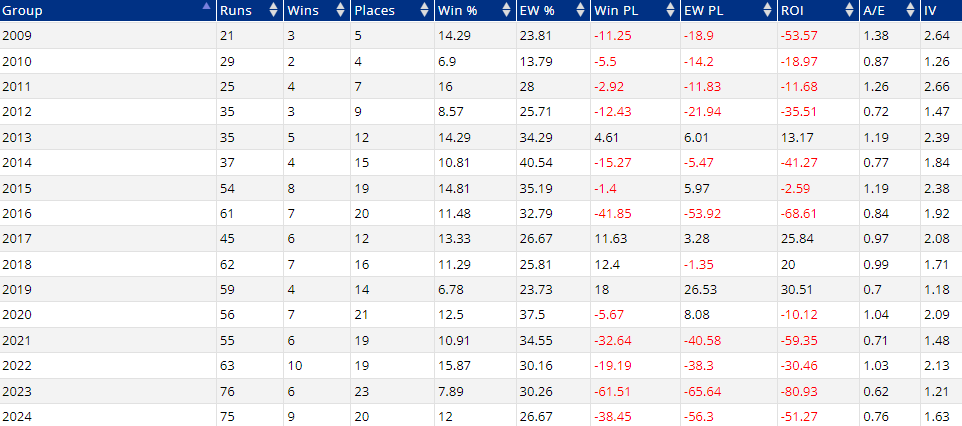
This is just Mullins, with between 1/3rd to 1/4’ish of winners of festival races, give or take the odd year where he had 4 or 6 winners and it’s been like that since 2015.
Now, the first thing I wanted to look at was the performance of the regular QT systems at Cheltenham compared to how they have performed away from the festival between 27th Feb-15th March.
Non-Cheltenham specific QT Systems
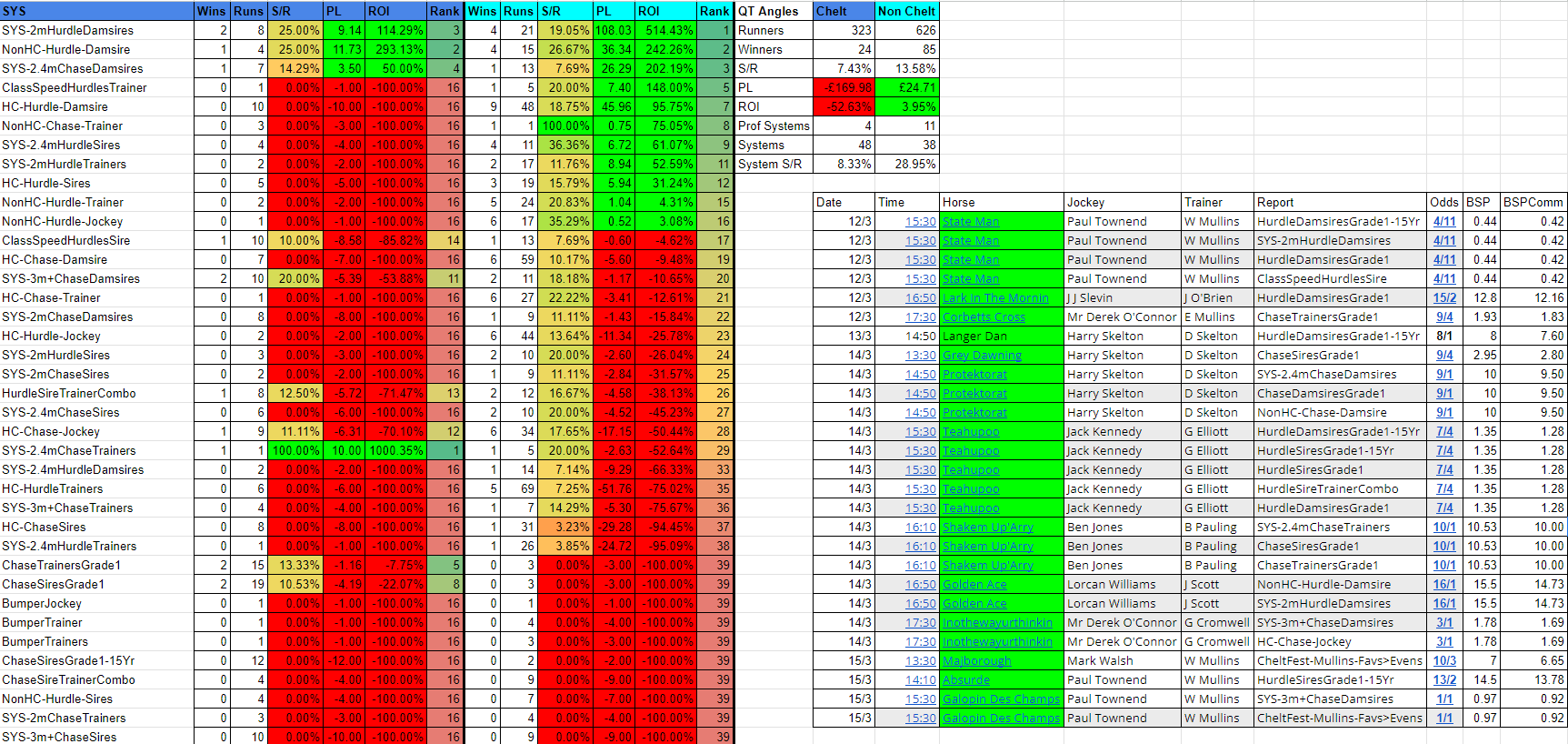
The ones on the left (in darker blue headings) are the QT systems from Cheltenham, the ones on the right (lighter blue headings) are the overall results of systems since 27th Feb 2024. All the winners are listed on the right. Only 4 winning systems at Cheltenham, but that is not surprising given there were 323 qualifiers with 24 wins in total and Mullins won’t show up on value-based systems so that is 9 races of the 28 out of the equation. Those 323 qualifiers are almost half of all the other qualifiers from all non-Cheltenham qualifiers for the 3 weeks prior to the festival! It’s encouraging that 3 of those 4 are overall the most profitable systems, all 3 damsire based systems in non handicap races. In fact overall, the only profitable system across any handicaps is the damsire in handicap hurdles. Maybe I’ll chop all jump systems to just be damsire-based! Makes sense as the general rule of thumb suggests stamina, and possibly class, is imparted from the dam’s line. However, it’s early days and if you look at some of the strike-rates for the slightly losing QT systems, they are not “too bad” and a decent price winner can change things dramatically.
My Research Notes: Look at all qualifying systems to see if small sample sizes produce too many qualifiers and not enough winners. Examine profiles and stats of winners. Monitor those that were both heavily unprofitable at both Cheltenham and overall and consider chopping those based on low S/R, AE/IV etc. Look back at split-sample testing. 2009 to 2017 System Set tested across 2018 - 2024 seasons to increase sample sizes and compare, to see if that helps.
Cheltenham-specific Based QT Systems
My thinking here was to record data “in the field” but ultimately I should have done split-sample testing. I also was not sure whether “last 5 year” or “last 15 year” systems would do better so recorded both and probably some crossover in terms of number of selections and winners.
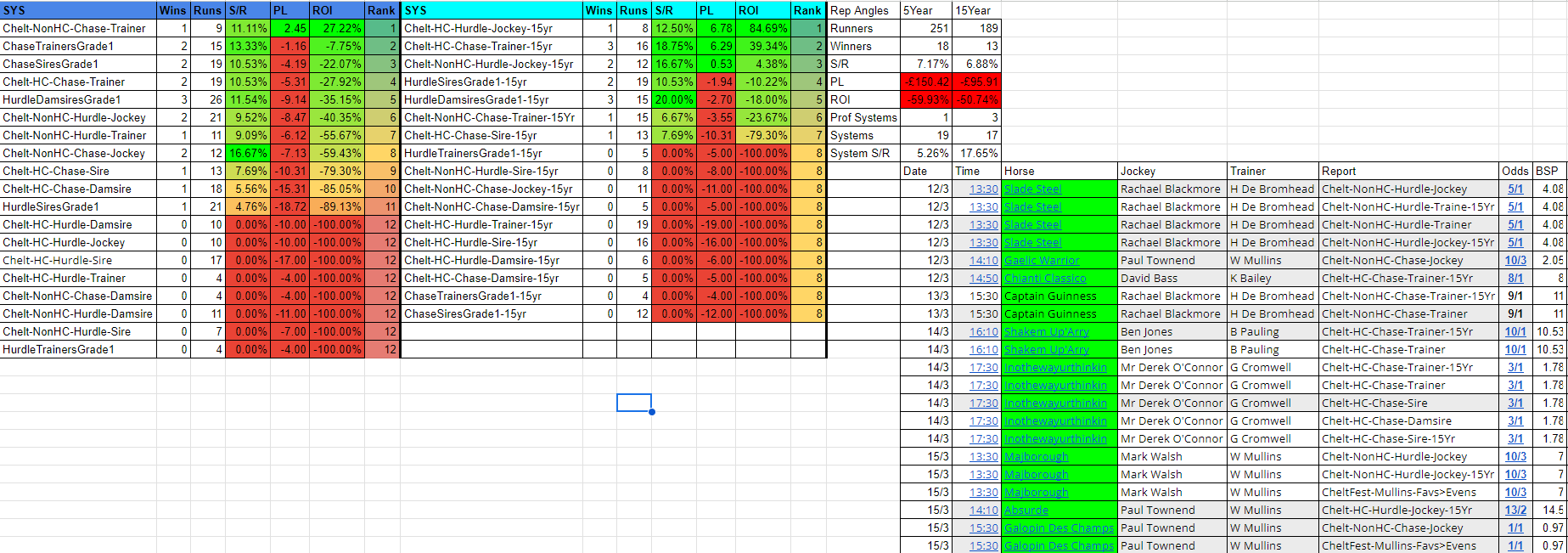
Of all the non-Cheltenham based systems, 5-year and 15-year, the 15-year ones lost the least due to the lesser number of qualifiers. Missed out on 5 wins that the 5-year produced and not too much difference in terms of S/R but far too many qualifiers. I’ll probably chop the 5 & 15 and replace them with one 10-year approach based on the above. I’ll then monitor the overall systems and remove the unprofitable ones, towards the end of the year and their Cheltenham counterparts.
My Research Notes: Look at all qualifying systems to see if small sample sizes produce too many qualifiers and not enough winners. Examine profiles and stats of winners. Monitor those that were both heavily unprofitable at both Cheltenham and overall and consider chopping. Look back at split-sample testing. 2009 to 2017 System Set tested across 2018 - 2024 seasons to increase sample sizes and compare. Consider 10-Year stats as an alternative single approach rather than 5 or 15 years to reduce selections and examine profit filters for each.
Handicaps v Non Handicaps
Obviously Cheltenham handicaps are notoriously difficult to win and perhaps with more embedded form, systems-based approaches are not the way to go. Lets start with the non-handicap races.
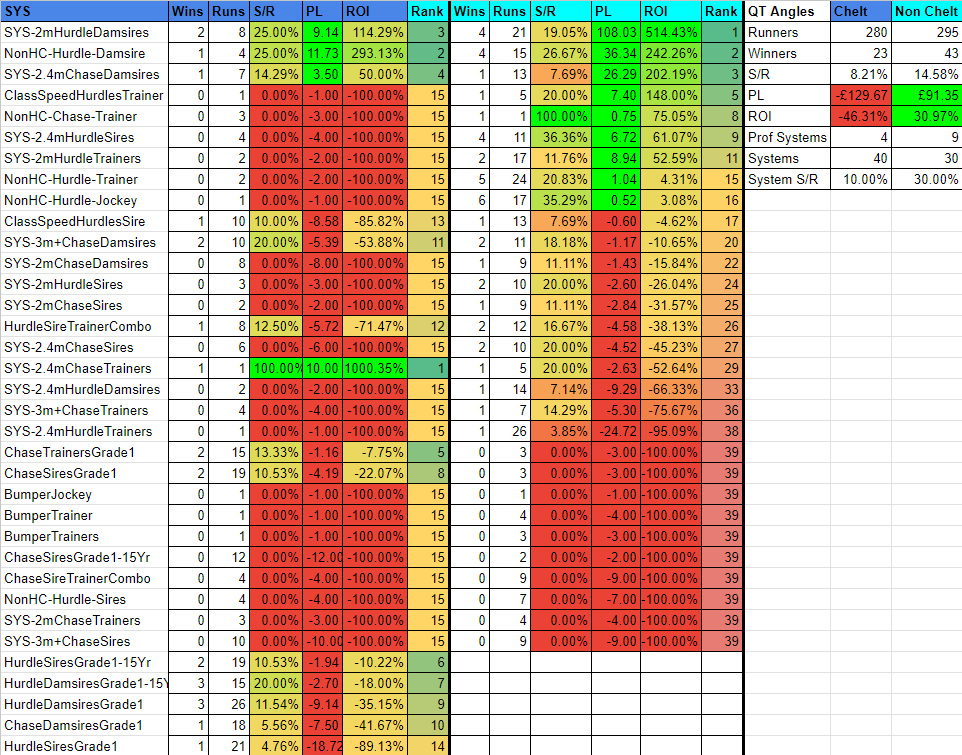
Well, as we can see from above, again that 3 systems that were profitable at Cheltenham are in the Top-3 overall which is encouraging, with high enough strike-rates and they are all damsire based.
The other was the 2.4m Chase Trainers. Overall those systems have a near 31% ROI and 14.58% S/R with 9 of the 30 systems being profitable. Again, small sample sizes. Ultimately, we need more data.
Now let’s check out the handicap races…
Now, both are losers with only 2 overall being profitable, hurdle damsires and hurdle chases. There are only a few points lost in chase damsire and trainer but the real damage is done in chases and with trainer or jockey-based systems it seems. It remains to be seen if any of those turn around but the number of qualifiers and low strike-rate for the hurdle trainers is something that needs looked at, as do the handicap chase sires with just 1/31 wins. Perhaps, again systems do not work as well in jumps handicaps, or it’s a case of just sticking with damsires.
My Research Notes: Consider adapting and tightening up trainer/jockey based or eliminating them altogether as they could be covered by more relevant GeeGeez report angles instead. Also, consider looking at the records of damsires to see if the AE/IV can be tightened up to increase their profitability. Examine sire data for handicap hurdles and consider dropping it for chases and focusing more on the damsire data.
CHASES v HURDLES
The above seems to suggest that chase races are not that great compared to hurdle races, but obviously we can split the categories out a bit.
Let’s start looking at Chases.
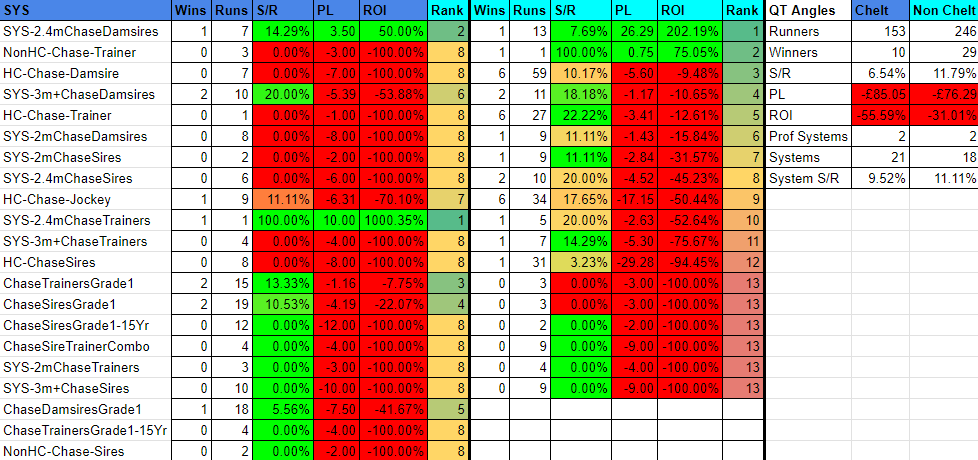
Now, we already know that non-handicaps perform better than handicap races for profitability and that hurdles are better than chases. There is an argument to only focus on non-handicap chases, but I also think there is an argument to only focus on non-handicap chase damsire systems and ignoring the rest of using a trends based approach for big handicap chase contests instead…Irish Grand National anyone? 2 profitable systems from 18 overall is simply not good enough with an 11.79% strike rate.
Now let’s look at hurdle races by comparison…
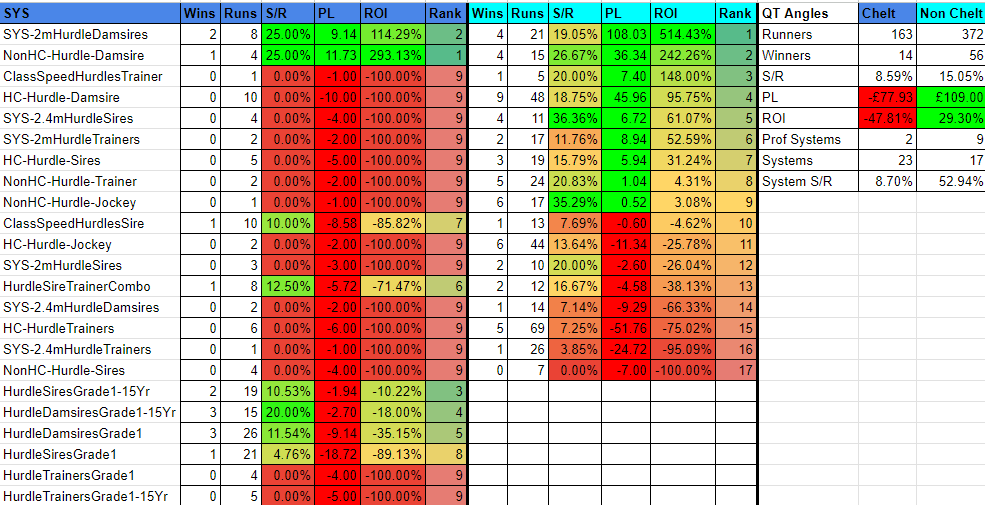
Again it’s encouraging, for me that the Top-2 systems at Cheltenham and the only ones that showed a profit were damsire based. Looking at the bottom, the Grade1 performance is not too bad, apart from sires and trainers (again) and the 15-year damsires in Grade 1 had a high strike-rate of 20 and small loss. Look at the overall systems record outside of Cheltenham though. 9 profitable hurdle-based systems. Now, if we ruled out trainer and jockey based systems we might lose a couple of profitable systems but overall, given how poor the handicap hurdle and 2.4m hurdle trainer are, we would probably gain an extra 60pts profit to improve upon the already-good 29% ROI. By implementing a 10-year single system rather than both a 15-year and 5-year, we consolidate losses for Cheltenham and perhaps a good idea to exclude sire-based hurdle angles.
My Research Notes: Consider focusing only on non-handicap chase damsire systems alongside traditional trends analysis for big chase races. Consider dropping hurdle trainer based systems, and perhaps jockeys and let the more specific Report Angles pick up qualifiers. This would improve ROI and reduce losses.
SUMMARY
I hope you can see what I was trying to do here. I will keep in place a lot of these systems for now but I will “copy” the systems for Aintree to see how they perform there. I have a feeling things like speed hurdlers will improve and at the end of the jumps season proper I will adjust filters slightly on the overall systems and consider chopping a few out, after recording during the summer jumps with a view to tightening things up for the 2025 jumps season in the NY. Time permitting I may look at trends for the big chase contests, starting with the Grand National as it has found decent winners in the past ie. Neptune Collonges, numerous big-priced Irish National winners and may be better suited to a trends, rather than a system-based approach.
For now my focus is on the flat while I’ll also do a similar exercise for the Report Angles Qualifiers. All of these systems are very much early days and will get tightened up as time goes on.
I find trends are good at producing a decent shortlist for handicap races at the Cheltenham Festival. I think you pointed-out last week that Mullins has broken the mould on the championship race trends - he does things his own way, and if that works he's not going to change it.
For handicaps though, trends (and important factors) rule. What I look for (which works for me) is young horses with no more than 15 races in the book, and having won at the trip (or further).
Example - Ultima h'cap Ch:
1st: Chianti Classico - 7yo; 10 previous races (3x NHF; 4x Hdl; 3x Ch) winner at the the trip (3-mile).
2nd: Twig - 9yo; 15 previous races (2x NHF; 6x Hdl; 7x Ch) won at the trip (3m2f & 3-mile).
3rd: Meetingofthewaters - 7yo; 17 prev races (2x NHF; 10x Hdl; 5x Ch); won at the trip (3-mile+)
I was on Twig at 28/1 as I thought the winner lacked big-field experience.
Then there are other clues from previous Festival form.
Example - Grand Annual Ch:
1st: Unexpected Party - 9yo; clue was close-up 5th in 2023 G1 "Turners" Nov Chase
Then there are trainer coups from either a sacrificial top-weight, ensuring the main-chance runs off a lower weight; or switching codes to take advantage of a low rating.
Example - Pertemps h'cap Hurdle
1st: Monmiral - 7yo; won G1 hurdle at Aintree in 2021 and rated OR153, ran off OR138 (had struggled off higher ratings in novice chases).
Some winners - like Shakem Up'Arry in the "Plate" - had been aimed at their target race. Shakem was 3rd in the Plate in 2023, and had shown improved form since (won over C&D). Even so, he was fortunate to beat the lightly-raced 7yo Crebilly, who could be a 155+ chaser with better jumping.
And then there are the potential "Gold Cup" winners running in a handicap; I'm think of the 6yo Inothewayyurthinkin who destroyed the Kim Muir field despite carrying 12st. Remember, Galopin Des Champs won a handicap hurdle at the Festival off OR142 (with subsequent dual Coral Cup winner Langer Dan in 2nd), and I can see Inothewayyurthinkin winning the Gold Cup in 2026.